
If you’ve been searching for free prop firm accounts, this is what I learned the hard way: most “free” offers aren’t funding… they’re filters.
I’ve tested these accounts the same way I test any prop setup, by pushing the rules (without breaking them), tracking how the daily loss, drawdown, and hidden restrictions actually behave in real trading conditions.
In this guide, I’ll show you the legit ways traders get access for $0, what to watch for so you don’t waste a month on a rigged approach, and the exact playbook I use to stay eligible while still aiming for top performance.
Here’s what you’re going to learn:
What “Free Funded Accounts” Really Means
In real life, free almost always means you get access to an account for $0, but you only earn a funded account/prize if you perform under strict rules.
Here’s what “free” typically looks like in the prop world:
- Free competitions (the legit $0 route to winning funded accounts)
Example of common structure: monthly event, leaderboard ranking, prizes, including funded accounts. - Free trials (useful for testing platforms, not the same as getting funded)
- Free promos that are really refund models (not $0 upfront, and not what most people mean by “free”)
We’ll discuss all these ways in detail now.
The 3 Legit Ways to Get a Free Prop Firm Account
1) Free Monthly Trading Competitions (The Only True $0 Path to Funding)
If you want a real shot at funding without paying, competitions are the best option. You register, you trade a competition account (usually demo), and if you finish high enough, you can win cash prizes and/or funded accounts.
A structure I’ve seen repeatedly (and tested) is:
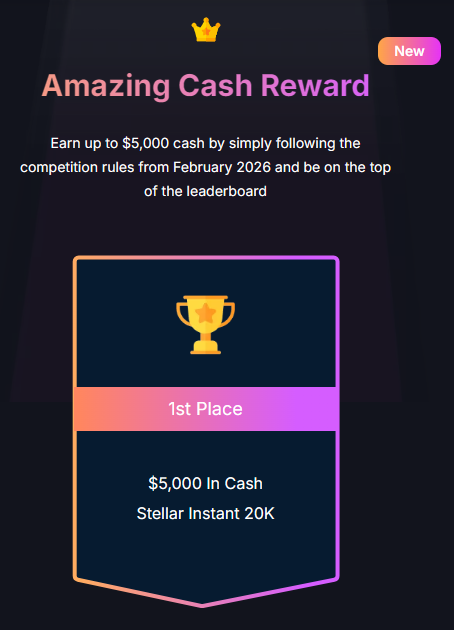
- Top 100 on the leaderboard get funded accounts
- Ranks 101-600 still get a chance via a lottery draw (ex: 50 winners)
This is the structure you can find in FundedNext.
The most important thing is the rule set, because it’s strict and instant:
- Daily loss limit: 5%, and it can include floating drawdown (open trades count)
- Max overall loss: 10%
- Minimum 5 trading days (so you can’t one-shot the month and disappear)
My experience: the fastest way to “lose” is thinking you can YOLO your way into first place and then getting hit by the daily loss rule before you even close the trade.
2) Free Trials (Great for Testing a Firm, Not a Free Funded Account)
A prop firm with a free trial is useful, but it’s not the same thing as free funding. It’s basically the firm saying: try our trading environment first, so you can get used to the execution and platform flow before you pay anything.
Trials help you answer practical questions fast:
- Is the platform stable when volatility appears?
- Are the spreads/commissions reasonable for your trading style?
- Can you navigate the dashboard and credentials smoothly?
My experience: I treat free trials like a platform audit. If I can’t place, manage, and close trades the way I like (especially around fast markets), I don’t care how good the offer sounds. And that’s because the real cost later is slippage + mistakes, and nobody wants that.
3) Net-Free Promos (Refund Models That Can End Up Costing $0)
Some firms offer deals where you pay upfront, and if you pass the prop firm challenge, you can get a refund (sometimes even more than your fee back). That can end up net-free, but it’s not the same as getting a free account on day one.
One example is FundedNext, which gives you 120% of your money back on your first payout.
On the futures side, you have, for example, Apex Trader Funding, which gives you $25,000 of your first profits with 100% profit split. In my opinion, this is even better than a direct fee refund, because it lets you get back much more than what you paid for the challenge itself.
My take from testing and watching others: this route only makes sense if you already trade with discipline, because repeated retries can fast become expensive. Competitions are a better starting point if your goal is truly $0 entry, because you can train under prop-style rules without paying any fees while you learn.
Filter 100's of Prop Firm challenges

Set your options and PropScan your challenge
Free challenge search tool
Case Example: The Monthly Competition Model
One of the most practical free prop firm accounts I’ve tested is the monthly competition format: you register, you get a demo account, you trade for the full month, and the best performers win prizes, including funded accounts.
This is the FundedNext model.
In this model, “free” is real: there’s no entry fee, but the rules are tight, and one bad decision can end your month instantly.
How the prizes typically work (and why this matters)
From what I saw on the competition page and rules, the incentive is clear: rank higher = better prizes, but you don’t need to be in the top 3 to win something meaningful.
- Top 100 on the leaderboard receive funded accounts
- Ranks 101-600 become eligible for a lottery, where 50 winners get funded accounts
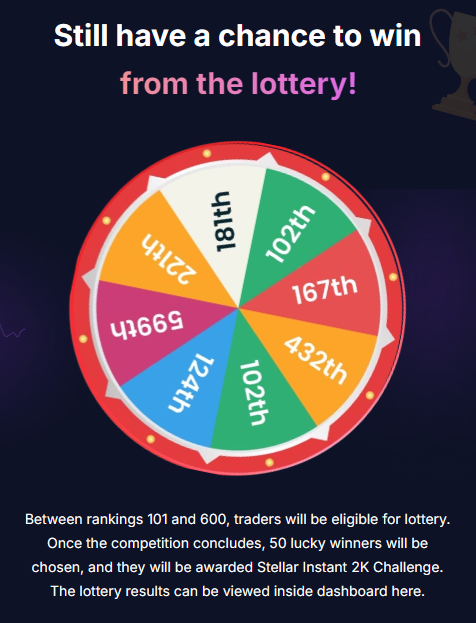
That “101–600 lottery” detail is important. You don’t need to flip the account or force trades to have a chance. You may just need to survive, stay eligible, and finish inside the range.
The rule set that decides if you last 48 hours or 30 days
Here’s the rule bundle that shows up again and again in this type of free competition account:
- Daily loss limit: 5%
- Daily loss includes floating loss (open trades count)
- Overall loss limit: 10%
- Minimum trading days: 5 (you can’t have “one lucky trade and disappear”)
- News trading allowed
- Commission: $3/lot for forex & commodities; no commission on indices
- Overnight + weekend holding allowed, and the account is swap-free
- EAs not allowed (so no robots)
- Limits like max lot size, max open positions, and max trades/day
- One account + one IP per person (multi-accounting gets you banned)
What to do differently when trading this format
Think in terms of survival first. Your target must stay comfortably inside the daily limit, not squeezing every pip out of the move.
The baseline approach in these competitions is:
- Keep risk small enough so that one trade can’t threaten the daily limit
- Hit the minimum 5 trading days early without forcing trades
- Only “press” later in the month if you’re still well inside drawdown and the market is good
The step-by-step flow (what you actually do)
This is the practical process I followed, and it’s straightforward:
- Register and join the monthly competition on the dashboard
- Get your platform credentials (typically via the competition profile/dashboard)
- Trade the full competition window (start of the month to the end of the month)
- Stay on the leaderboard and follow the rules until the competition ends
And importantly: there are usually no resets during the month. If you break the rules, that account is done.
A quick warning about leaderboards
In my testing, the leaderboard can look insane mid-month. You may see people posting massive percentages that don’t even look real. I’ve also seen explanations that some of those top performers don’t end up qualifying at the end due to unacceptable methods, so the visible ranking can be misleading.
That’s why you shouldn’t try to trade this format to beat the craziest number on the board. Trade it to stay eligible and let the month play out.
Advantages of Free Prop Firm Accounts
1) You can get a real shot at funding with $0 entry
Competitions are the closest thing to “true free” in this space: you join, trade, and if you place high enough (or land in the eligible lottery range), you can win a funded account.
2) They force discipline fast
A daily loss cap like 5% (especially when it includes floating loss) forces you to trade with a good prop firm risk management instead of gambling.
What I’ve personally seen people getting better at from these rules:
- Cutting size earlier
- Avoiding revenge trades
- Respecting the “one bad trade can end the day” mentality
3) They’re a low-risk way to test the firm’s ecosystem
Even when the account is demo, you still see the important stuff:
- Platform flow and dashboard usability
- Instrument list
- Rules clarity (and how they fit your strategy)
4) Swing traders often get decent conditions in competitions
Some competition formats allow overnight/weekend holding and can even be swap-free, which is a big deal if you hold trades longer than a session.
5) News trading may be allowed (depends on the competition)
If you trade volatility, seeing “news trading allowed” can be helpful, as long as you’re disciplined with slippage and drawdown.
Disadvantages of Free Prop Firm Accounts
1) The leaderboard incentives may push you into bad habits
A lot of people blow the account or break the challenge rules because they try to catch up to someone having crazy numbers.
If you’ve ever said, “I just need one big trade”, that’s the mindset these competitions punish.
2) Floating drawdown rules can knock you out even if your idea is correct
When the daily loss includes floating loss, you can get disqualified on an open trade that later would have turned into a profit. That’s hurts if you oversize or trade instruments that spike (gold, indices during news).
3) Strategy restrictions can limit how you normally trade
Common competition restrictions I’ve seen include:
- No EAs/robots
- Caps like max lot size, max open positions, max trades/day
If your edge relies on scaling in with many positions or high-frequency execution, these rules can basically kill your system.
4) Eligibility rules can waste your month if you ignore them
Many formats require minimum trading days (like 5 days) and enforce things like one account / one IP per person. These are easy to miss if you only focus on trading and don’t properly read all the rules first.
FAQ
Yes, but “free” usually means free access to a competition or trial, not guaranteed funding. The legit $0 route is typically a monthly competition where performance (and rule compliance) decides whether you win a funded account.
It’s possible through competitions: you enter for $0, trade, and if you finish high enough (or qualify for a lottery range), you can receive a funded account. A common setup is Top 100 funded, plus a lottery for ranks 101-600 (example: 50 winners).
A free trial is mainly to test the platform and rules. It’s practice, not funding. A free competition account can lead to a funded account as a prize, but you must survive strict risk rules for the full competition window.
The big one is the daily loss limit, especially when it includes floating drawdown (open trades count even before you close them). Many competition models use something like 5% daily loss and 10% max loss overall.
It means your account can violate the rule while the trade is still open, if your unrealized drawdown crosses the daily limit. In practice, this punishes oversizing and wide stop approaches.
Often no, many free competition accounts explicitly ban EAs/robots. If your strategy depends on automation, you need to confirm this rule before you trade.
Sometimes yes (especially in competition formats), but it depends on the ruleset. I’ve seen competitions state news trading allowed, which is great only if you respect slippage and don’t let a spike push you into a floating drawdown.
Some free competition accounts allow overnight and weekend holding, and some can be swap-free. That’s a big advantage if you swing trade and don’t want holding costs to distort results.
They can. For example, I’ve seen rule sheets where forex/commodities have a commission per lot, while indices may have no commission, so your costs depend heavily on what you trade.
Many competitions enforce minimum trading days (example: 5 days). If you trade only 1-2 days and stop, you can lose eligibility even with good performance.
Usually not. Rules commonly include one account per person and sometimes one IP rule, and breaking that can get you removed.
My rule is simple: survive first, push later. I size positions so a normal pullback can’t trigger the daily loss limit, then I only increase the risk after I’ve locked in eligibility (like the minimum trading days).
Conclusion
Free prop firm accounts are real, but the “free” part usually means free access to compete, not free money. The only reliable $0 path I’ve personally tested is the monthly competition model, where you can win a funded account if you perform and respect rules like daily loss (often including floating drawdown), overall drawdown limits, and minimum trading days.
If you treat these accounts like a casino, you’ll lose fast. If you treat them like a rule-based performance test, they become one of the best ways to build funded-trader discipline without paying evaluation fees.